Key takeaways
- Electric cars, smart homes and AI are not passing trends, they are reshaping daily life, with real benefits and real concerns.
- EVs have improved hugely, with 350+ mile ranges and faster charging, and electric buses have already helped clean up Manchester's air.
- Smart homes bring convenience and energy savings, but more devices mean more data, so privacy and security matter.
- AI is hugely powerful and promising, especially in healthcare, but raises real questions about jobs and control. The key is to stay informed and use it wisely.
- From 2030 the UK stops selling new pure petrol and diesel cars, so getting your head around EVs now is time well spent.
- Since April 2024, UK law requires smart devices to meet basic security rules, but you still need good habits of your own.
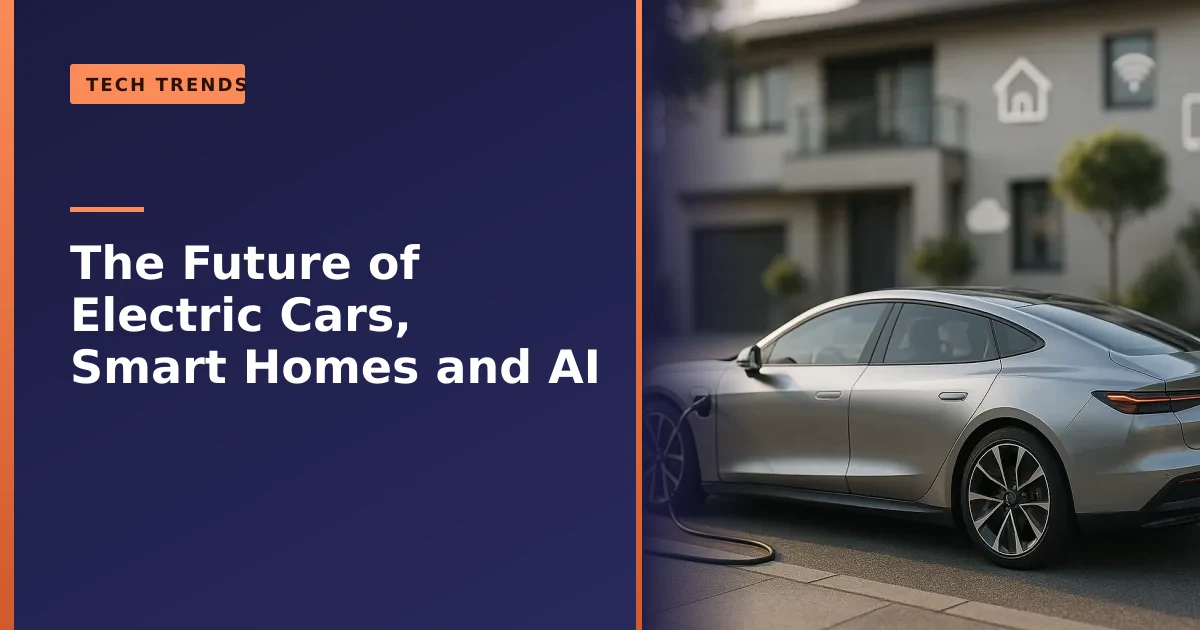
Where is technology actually heading, and should we be excited or worried? Honestly, both. As someone who works with computers and laptops every day, I have watched electric cars, smart homes and AI go from novelties to things ordinary people in Manchester now live with. They are not going away. So rather than dismiss them or blindly embrace them, the real question is how we use these innovations to enhance our lives rather than disrupt them. Here is my honest take on all three, with the 2026 facts to back it up. This is an opinion piece from a technician, not a sales pitch: I will give you the upsides honestly, and the downsides just as honestly.
Electric cars: the road to cleaner air?
Walk through any major city, Manchester, London, Munich, Paris, and the air is thick with fumes. Cars are everywhere, and urban pollution is hard to escape. Fuel efficiency improved over the years, but not enough, and now the shift to electric vehicles is happening fast, with governments pushing greener solutions and manufacturers investing heavily. I was sceptical for a long time, who wants to sit at a charging station for hours? But things have genuinely changed: ranges of 350+ miles on a charge, much faster charging, and expanding infrastructure make EVs far more viable. Manchester's air has already improved with electric buses, and walking through cleaner streets feels good. Concerns remain, what happens to old batteries, and how sustainable is mass production, and these need addressing. But compared with standing next to a diesel bus belching smoke, the benefits of a silent, zero-emission one are obvious. The UK's plans to phase out new petrol and diesel cars only accelerate the shift.
Why does this matter so much for a city like ours? Because the air is not just unpleasant, it is genuinely harmful. The World Health Organization estimates that outdoor air pollution caused roughly 4.2 million premature deaths worldwide in 2019, and that around 99% of the world's population lives in places where its air quality guidelines are not met. Closer to home, Manchester City Council openly states on its air quality page that the annual concentration of nitrogen dioxide regularly exceeds the legal objective, especially in the city centre and beside busy roads. Nitrogen dioxide mostly comes from traffic, and it hits children, older people and anyone with asthma hardest. In those terms, the case for cleaner vehicles stops being abstract.
The 2030 deadline and what it actually means
There is a lot of confusion about the petrol and diesel ban, so let me set it out plainly, because it affects what you should buy next. The UK government has confirmed that the sale of brand-new pure petrol and diesel cars and vans will end in 2030. Between 2030 and 2035 some hybrids that can travel a meaningful distance on electric power alone may still be sold, and from 2035 every new car and van must be fully zero-emission at the tailpipe.
A few things people get wrong about this:
- It is not a ban on your current car. You can keep driving, buying and selling petrol and diesel cars second-hand well beyond 2030. The deadline is about new sales only.
- It is being phased, not flipped overnight. Manufacturers are working to the Zero Emission Vehicle (ZEV) mandate, which sets a rising percentage of new sales that must be electric each year, with some flexibility built in for the trade.
- The infrastructure is being funded alongside it. The government has committed substantial money to charging infrastructure and to helping factories retool, which matters if the switch is going to work for ordinary drivers and not just early adopters.
My honest view: if you are buying a car in the next few years, you do not need to rush into an EV out of panic, but it is worth understanding them properly, because the second-hand EV market (where most of us actually shop) is growing quickly.
What happens to old EV batteries?
This is the question I get asked most, and it is a fair one. A car that cleans the air while it drives is not much use if its battery becomes toxic landfill at the end. The good news is the figures in 2026 are genuinely reassuring. Independent fleet analysis covering more than 22,000 vehicles puts average battery degradation at roughly 2.3% a year, meaning a typical pack still holds about 81.6% of its original capacity after eight years. In plain terms, the battery is not going to fall off a cliff the moment the warranty ends, which was my old fear. Most are built to last 15 to 20 years.
When a pack finally drops below the level that is useful in a car, it does not go straight to the scrap heap. There are two stages:
- Second life. A battery that is too weak to push a car along the M60 can still happily store energy in a building or on the grid. Several major manufacturers run programmes that repurpose used packs for stationary energy storage.
- Recycling. When a pack is truly finished, the valuable materials (lithium, nickel, cobalt) can be recovered. The UK has been building dedicated recycling capacity, and modern processes can recover a high proportion of a pack's materials, with regulatory recovery targets rising over the coming years.
It is not a solved problem. Mining the raw materials still has a real environmental and human cost, and recycling at scale is still ramping up. But the trajectory is the right one, and it is far better than the "batteries just get buried" story I used to believe.
Electric versus petrol: a quick reality check
Rather than cheerlead, here is a balanced comparison of where things genuinely stand in 2026. Treat the numbers as typical ranges, not promises, because real life (cold weather, motorway speeds, a full boot) always takes a bite.
| Factor | Electric vehicle | Petrol or diesel |
|---|---|---|
| Real-world range | Around 180 to 350 miles depending on model and conditions | Typically 400+ miles per tank |
| Refuelling time | Minutes on a rapid charger, hours on a home charger | A few minutes anywhere |
| Tailpipe emissions | None | CO2, nitrogen dioxide and particulates |
| Running cost | Usually lower, especially charging at home overnight | Higher and more exposed to fuel prices |
| Upfront cost | Often higher new, but the used market is closing the gap | Generally lower upfront |
| Maintenance | Fewer moving parts, so often less servicing | More mechanical wear over time |
The honest summary: if you mostly do local and commuter miles and can charge at or near home, an EV is hard to argue against. If you regularly do long, unpredictable journeys with no time to plan charging, the calculation is closer, though it shifts in the EV's favour every year as the network grows.
Smart homes: convenience or overreach?
Ten years ago, smart homes felt like a gimmick. Then Google Home and Alexa arrived, and controlling your lights, heating and security by voice or app became normal. The appeal is efficiency: turn off lights you left on, schedule the heating, check cameras from your phone, all of which can make life easier and cut energy waste. But there is a trade-off. More smart devices mean more data collection, your habits, routines and interactions are being recorded, and that raises real questions: who owns that data, and how secure is it? These are worth asking as we add more AI-driven tech to our homes, and good security habits matter, the kind we cover in our guide on working securely, along with strong passwords and a firewall.
Let me be specific about the savings, because vague "it saves energy" claims annoy me. A smart thermostat saves money mainly by not heating an empty house and by letting you heat the rooms you use when you use them. Smart plugs kill the standby power on appliances that quietly sip electricity all day. None of this is magic, it is just removing the small, daily waste that adds up over a year, and it stacks up alongside other good habits, including the energy-saving basics in our piece on better battery and power performance.
Making a smart home that is actually secure
Here is where my technician hat goes on. I have seen the downside up close: cameras left on default passwords, and a hacked account that gave a stranger a view inside someone's living room. The risk is not a reason to avoid smart devices, it is a reason to set them up properly.
The UK actually has your back here more than it used to. Since 29 April 2024, new law requires smart devices sold in the UK to meet basic cyber-security requirements: no lazy default passwords that are shared all over the internet, and a clear statement of how long the device will receive security updates. The National Cyber Security Centre, part of GCHQ, has plain-English guidance on using smart devices safely in your home, and it is well worth ten minutes of your time. Here is my own checklist, built on their advice:
- Change every default password the moment you set a device up. The NCSC suggests three random words for something strong and memorable.
- Turn on two-step verification (2SV) wherever the app offers it. It is the single best defence even if your password leaks.
- Install updates promptly, and turn on automatic updates if available. Outdated firmware is how most home devices get compromised.
- Check the support "use by" date. A cheap camera that stops getting updates in a year is a liability, not a bargain.
- Secure your home WiFi with a strong, unique password, and consider putting smart gadgets on a separate guest network so they cannot reach your main computers.
- Disable remote access you do not need, and factory reset any device before you sell or bin it.
- Buy from reputable brands that publish their support policy. If you cannot find out who made it or how long it is supported, that tells you something.
None of this is hard, and it turns a genuine risk into a manageable one. If you think an account has been compromised, our notes on what to do if you have been hacked and our virus removal service are good starting points.
Matter: why your gadgets are finally starting to talk to each other
One of the most frustrating things about early smart homes was that nothing worked together. A bulb from one brand would not talk to a hub from another, and you ended up with five different apps for one house. That is changing thanks to a standard called Matter, and it is one of the few smart-home developments I am genuinely pleased about.
Matter is an open connectivity standard backed by the Connectivity Standards Alliance, and crucially it is supported by Amazon, Apple, Google and Samsung at the same time, which almost never happens. You can read about it on the Alliance's own Matter page. The idea is simple: a device with the Matter logo should work reliably across the major ecosystems, set up easily, and run locally rather than depending entirely on someone's cloud. By 2026 the standard has matured well past the experimental stage, with support spanning lighting, switches, sensors, locks, cameras and energy management.
My practical advice: if you are starting fresh or replacing kit, look for the Matter logo. It reduces the chance you lock yourself into one company forever, and devices that run locally keep working even when the manufacturer's servers have a bad day. It is not perfect, but it is a big step in the right direction.
AI: the real game-changer
AI is where things get genuinely exciting, and a little unsettling. We have heard about it for years, but it was not until I started using tools like ChatGPT that I realised how powerful it had become, the way it understands and responds is almost human-like. The potential is staggering: AI analysing millions of medical research papers to find new treatments, diagnosing diseases with great accuracy, streamlining logistics and public safety. But there is a flip side too, AI will be used in warfare, will replace some jobs, and may become so advanced that we struggle to understand its decisions. That is the part that unsettles me. Used responsibly, AI will improve lives; used carelessly, it brings risks we will have to manage. When building AI tools, it is worth using the most capable, well-aligned models and keeping a human in the loop.
Generative AI is now part of everyday life
What struck me most over the last couple of years is how quietly AI slipped into ordinary tasks. It is no longer a website you visit, it is baked into the tools you already use. Your phone keyboard suggests whole sentences, your email drafts replies, search engines summarise answers before you have clicked anything, and office software writes a first draft of a report or cleans up a spreadsheet formula in seconds.
Used sensibly, this is brilliant for productivity. I use AI to draft, to summarise long documents, and to explain an unfamiliar error message. The key word is draft. AI is a fast, tireless assistant that is occasionally confidently wrong, so I treat everything it produces as a first attempt to be checked, never as gospel. A couple of habits keep me out of trouble:
- Never paste sensitive personal or business data into a public AI tool unless you know exactly where it goes. Treat the chat box like a postcard, not a sealed letter.
- Always verify facts, figures and quotes. AI can invent things that sound completely plausible. If it matters, check it against a real source.
- Watch what extensions you install. Plenty of "AI helper" browser add-ons are slow, nosy, or worse. Stick to reputable ones, the same caution we urge in our guide to spotting dodgy websites and scams.
AI in healthcare: the part that gives me hope
If you ask me where AI does the most obvious good, it is healthcare. The NHS is already using AI tools in real settings, and the early signs are encouraging. So-called ambient AI "scribes" listen during a consultation and write up the structured notes, which frees clinicians from paperwork and gives them more time with patients. That tackles two things the NHS desperately needs: lost time and staff burnout.
Beyond admin, AI is good at spotting patterns in images and data, which lends itself to reading scans, flagging risks earlier, and helping researchers sift through enormous amounts of medical literature far faster than any human could. The UK's medicines regulator is working on a dedicated framework for AI in healthcare, which matters, because in medicine "move fast and break things" is exactly the wrong attitude. The 2026 direction is sensible: use AI to support clinicians and cut admin now, and roll out validated diagnostic tools carefully as they prove themselves. That is the responsible version of the AI future, and the one I am rooting for.
AI, jobs and the questions that keep me up
Now the uncomfortable part. Every wave of technology has changed work, and AI is no different, except it is reaching into tasks we used to think were safe, the writing, summarising and analysis that white-collar jobs are built on. I do not buy the doomsday "everyone is redundant" headlines, nor the breezy "it will only create jobs" line. The truth is messier.
What I see, in my own work and in the people I talk to, is this: AI rarely replaces a whole job, but it changes most of them. It takes over the repetitive parts and raises the bar on the human parts, judgement, relationships, accountability, and knowing when the machine is wrong. The people who do well are not necessarily the most technical, they are the ones willing to learn the tools and stay adaptable. My honest advice is to get hands-on with AI now, while the stakes are low, so it becomes a tool you command rather than a wave that knocks you over.
How AI is being kept in check
What genuinely unsettles me is not today's chatbots, it is handing important decisions to systems whose reasoning we cannot fully follow. So I am glad regulation is catching up, even if imperfectly. The clearest example is the European Union's AI Act, the first major law of its kind, which takes a risk-based approach: it bans a small number of unacceptable uses, puts strict requirements on "high-risk" systems (think recruitment, finance, critical infrastructure), and requires transparency so you know when you are dealing with an AI or looking at AI-generated content. You can read the European Commission's own overview of the regulatory framework for AI. The rules are being phased in across 2025 to 2027, with obligations on the most powerful general-purpose models already in force. The UK is taking a lighter, sector-led path instead. The principle behind both is right: the more powerful the system and the higher the stakes, the more human oversight and accountability it should have. As an ordinary user, the takeaway is simpler, be a little sceptical and careful about what you trust an AI to decide for you.
Common myths, and the facts
Let me clear up the things I hear most often, because a lot of the fear and the hype are both built on outdated information.
| The myth | The reality in 2026 |
|---|---|
| EV batteries die after a few years | Typical packs retain around 80% capacity after eight years and are built to last 15 to 20 |
| EVs are dirtier than petrol once you count the battery | Manufacturing has a footprint, but over its life an EV charged on an increasingly clean grid comes out ahead, with zero tailpipe pollution |
| Smart devices are inherently unsafe | Set up properly, with updates and 2SV, they are fine. UK law now bans default passwords too |
| AI "understands" like a person | It predicts plausible text and patterns extremely well, but it has no real understanding and can be confidently wrong |
| AI is coming for all our jobs next year | It is changing tasks faster than it is deleting whole jobs. Adaptability matters more than panic |
My honest advice: how to live well with all this
After all the research and all the years tinkering, here is how I personally try to approach new technology, and what I would suggest to anyone in Manchester wondering whether to lean in or hold back.
- Adopt for a reason, not for the badge. Buy the EV because the sums work for your driving, the smart thermostat because you waste heat, the AI tool because it saves you real time. Novelty wears off fast.
- Secure everything you connect. A device on your network is a door into your home. Strong passwords, updates and two-step verification are non-negotiable.
- Keep a human in the loop. Whether it is an AI draft or an automated home routine, check the output and keep the ability to override it.
- Back up the things you cannot lose. The more our lives run on devices and cloud accounts, the more it hurts when one fails, so our guide on why backing up your data is critical applies more than ever.
- Repair before you replace. The greenest gadget is often the one you already own. We are firm believers in the right to repair, and a slow laptop is usually fixable, not finished.
- Stay curious, stay sceptical. Read the official sources, try the tools yourself, and do not take either the hype or the doom at face value.
Where do we go from here?
Electric cars, smart homes and AI are not passing trends, they are shaping the future whether we like it or not. There are legitimate concerns, but also massive benefits: cleaner cities, more efficient homes, and groundbreaking advances in medicine. The key is to be aware, stay informed, and use technology wisely, getting the good while staying alert to the downsides. I am cautiously optimistic. The tools are powerful, the safeguards are slowly catching up, and most of the risk that lands on ordinary people comes down to a handful of good habits.
How Manchester PC fits in
As technology advances, our job stays the same: helping people get the best from it, safely and affordably. Whether it is securing your smart-home devices, sorting a slow laptop, setting up a sensible backup, or just giving honest advice on what to buy, we are here with straight-talking, jargon-free help. We cover Manchester and the surrounding areas with free local collection and return, get a free quote or call 0161 820 1992.