Is be quiet! a Good PSU Brand?
If you have landed here after searching “Is be quiet! a good PSU brand?”, the short answer is yes. be quiet! is a genuinely reputable power supply brand, and in the current market it offers one of the clearest and most complete ranges for people who care about low noise, solid reliability and modern GPU compatibility.
That answer is not based on marketing alone. It is backed by more than 20 years in quiet PC hardware, a broad current PSU lineup, long warranty coverage on the key enthusiast ranges, and strong results in independent reviews and certification databases.
What is also worth noting is that Reddit’s own tone on the subject is broadly positive. The recurring community answer is not “avoid the brand”; it is “yes, generally good, but check the specific model”. That is sensible advice for any power supply brand, because PSUs should always be judged by the exact series, platform, feature set and testing, not only by the badge on the box.
The good news for be quiet! is that once you move away from vague brand talk and into actual products, the company’s current Pure Power, Straight Power, Power Zone and Dark Power lines hold up very well under scrutiny.
be quiet! describes itself as a German premium brand founded in 2001, with products developed and designed in Germany and final quality control near Hamburg. Its PSU history is central to that identity, and the company is the market leader in the power supply sector in Germany. Just as importantly, the brand’s fan technology is not generic. be quiet! ties its low-noise reputation to specially developed Silent Wings fan designs, fluid-dynamic bearings, optimised airflow and anti-vibration measures. The quietness people associate with the name is built into the design philosophy of the range, not added at the last minute as a marketing line.
The be quiet! PSU Range Explained
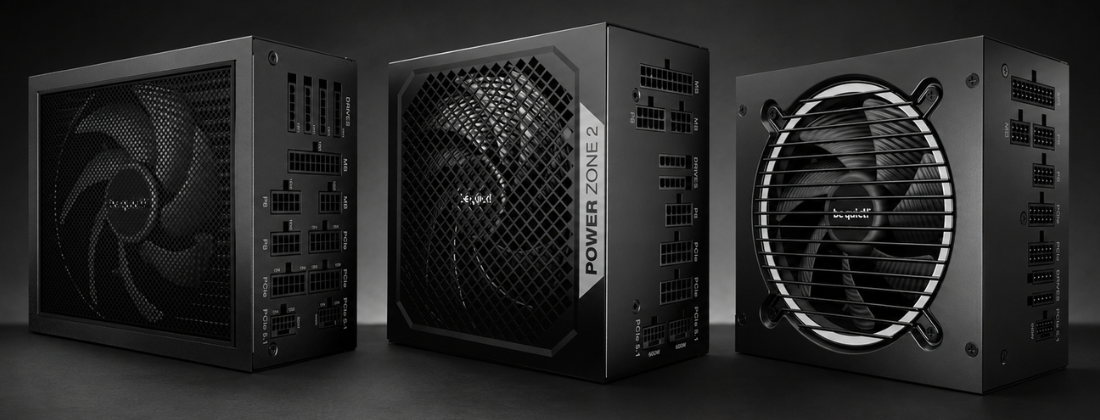
The easiest way to understand be quiet! PSUs is to stop thinking of them as one monolithic brand and instead look at the range in tiers. The current lineup places Dark Power 14 at the flagship end, then Dark Power 13, then Straight Power 12, then Power Zone 2, then Pure Power 13, Pure Power 12 and System Power 11 at the value end.
Each range has a clear role. Dark Power is for top-end, low-noise enthusiasts and workstation users. Straight Power is premium quiet performance for serious builds. Power Zone 2 is a modern gaming-focused Platinum line with semi-passive behaviour. Pure Power is the mainstream sweet spot for the majority of builders. System Power covers value-oriented buyers who still want current standards and brand-backed reliability.
That product stack is one of be quiet!’s biggest strengths. It gives shoppers a sensible path from affordable to flagship without leaving the brand, and each tier feels genuinely distinct rather than just being the same thing with a different sticker.
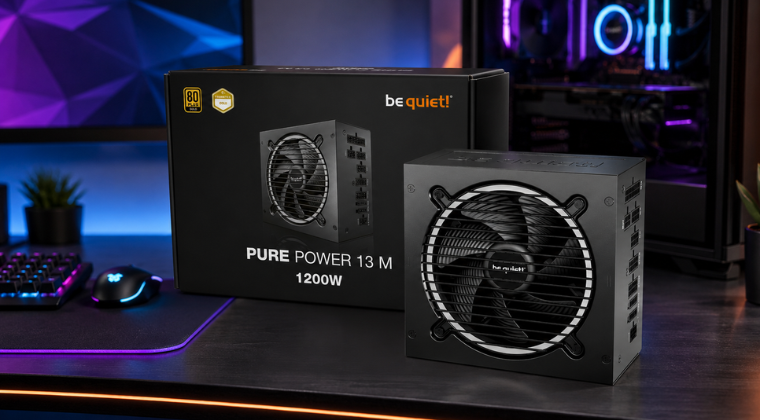
Pure Power 13 M
For most customers, the real centre of gravity is Pure Power 13 M. It is easy to recommend because the spec sheet already covers the features buyers care about most: ATX 3.1, PCIe 5.1 support, a native 12V-2×6 connector, semi-passive cooling, LLC topology, fully modular cabling and a 10-year warranty. On the 850W model, be quiet! lists up to 94.4% efficiency at 230V, which is an impressively strong number for a unit sold with an 80 PLUS Gold badge.
Independent testing reinforces that positive picture. Tom’s Hardware found that the Pure Power 13 M 650W delivered efficiency at a Platinum-like level despite its Gold certification, alongside excellent voltage regulation and very strong ripple suppression. Hardware Busters reported that the 850W model carries Cybenetics Platinum efficiency and a top-tier LAMBDA A++ noise score. In plain terms, Pure Power 13 M is not merely “good for the money”; it is a very serious mainstream unit that competes on real electrical performance and acoustic quality.
Pure Power 12 M
If you still see Pure Power 12 M in stock, that is also a positive story rather than a compromise. The 12 M offers ATX 3.0 compliance, PCIe 5.0 support, fully modular cabling, LLC-based stability, dual 12V rails and a 10-year warranty. Hardware Busters noted that the 850W model is quiet, efficient enough to earn a Cybenetics Platinum rating despite its 80 PLUS Gold badge. For anyone shopping on value, older Pure Power 12 M stock is still a highly sensible buy when priced well.
Straight Power 12, Power Zone 2 and the Dark Power Range
Straight Power 12
Move one tier higher and you reach Straight Power 12, which is where be quiet! starts leaning hard into premium refinement. Straight Power 12 is a Platinum-class line built around full bridge LLC technology, high-quality Japanese capacitors rated to 105°C, a Silent Wings 135mm fan, ATX 3.x and PCIe 5.x compatibility, long sleeved cables for bigger cases and a 10-year warranty.
Tom’s Hardware’s Straight Power 12 750W review praised the unit’s build quality, performance, efficiency and near-silent operation. The review also noted the use of an FSP platform, a Silent Wings 3 135mm fluid-dynamic-bearing fan and premium Japanese capacitors on the secondary side. If your priorities are lower noise, better materials and a “buy once, keep it for years” feel, Straight Power 12 is one of the easiest recommendations in the be quiet! catalogue. It is the range that tends to make sense for premium gaming PCs, creator builds and quiet workstations that are too important to leave on entry-level power.
Power Zone 2
A slightly less obvious but very interesting part of the range is Power Zone 2. be quiet! positions it as a Platinum-efficiency, ATX 3.1, PCIe 5.1-ready line with semi-passive zero-RPM cooling, a Pure Wings 3 140mm fan and a 10-year warranty. Tom’s Hardware highlighted its acoustic performance and thermal management, while Hardware Busters called the 750W model dead silent and highly efficient, saying it is particularly attractive for buyers who want a capable PSU that behaves almost like a passively cooled unit in practice. For shoppers who want a quieter gaming-focused PSU without jumping all the way to Dark Power money, Power Zone 2 is the sleeper pick in the lineup.
Dark Power 14 and Dark Power Pro 13
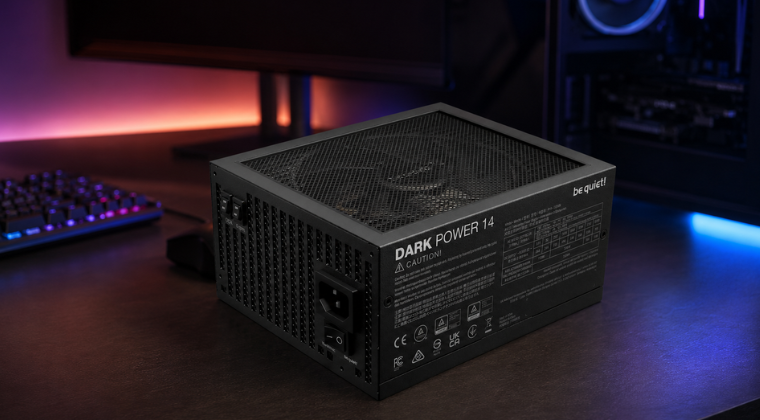
At the top sits Dark Power 14, and this is where be quiet! really shows what the brand stands for at flagship level. The range offers 80 PLUS Titanium and Cybenetics Titanium efficiency, ATX 3.1, PCIe 5.1 compatibility, active and semi-passive cooling modes, switchable multi-rail and single-rail operation, premium Japanese capacitors and a 10-year warranty. On the 1000W model, be quiet! details the rear button for switching between active and semi-passive cooling, the use of a Silent Wings fan, an integrated aluminium heatsink concept and native 12V-2×6 support for modern high-power GPUs. Hardware Busters includes Dark Power 14 in its best ATX v3.x and PCIe 5.x picks and reports Cybenetics Titanium efficiency with very low noise ratings. This is not marketing fluff; it is a flagship PSU behaving like one.
The Dark Power Pro 13 family still deserves mention because many buyers search for it directly. be quiet! positions it as Titanium-efficiency, next-generation power with overclocking-key rail switching, premium Japanese capacitors, strong protections, ATX 3.x support and a 10-year warranty. Dark Power Pro 13 is for the person building a no-compromise system who wants single-rail or multi-rail flexibility. If Dark Power 14 is the newest expression of the flagship idea, Dark Power Pro 13 remains a very relevant premium option.
Are be quiet! PSUs Reliable?
In practical terms, yes, and there are several reasons that answer is credible.
First, the better-known lines are built around the features you actually want in a long-term PSU purchase: modern standards support, strong protections, reputable platforms, premium components on the higher tiers and long warranties. Straight Power 12 and Dark Power 14 both explicitly list full protection coverage against over-current, over-voltage, under-voltage, short circuits, overheating, overload and input-side surge conditions. Pure Power 13 M and current ATX 3.1 ranges also emphasise power-excursion handling designed for modern GPUs.
Second, the review evidence is not thin. Tom’s Hardware, Hardware Busters and Cybenetics all give be quiet! current-generation products strong technical credibility.
Third, the company’s entire reputation is bound up with low-noise engineering, which is much harder to fake consistently than a spec-sheet badge.
The point about transient spikes is especially relevant if you are running a high-end GPU. Intel’s current ATX 3.1 guidance addresses this directly, and be quiet!’s ATX 3.x models are explicitly designed to handle large power excursions. If you want to go deeper on GPU power cable safety, our guide on daisy-chain PCIe power cables on GPUs covers exactly when and how to use them safely with be quiet! units.
650W or 750W? Choosing the Right Wattage
This is one of the most common questions people ask in PC building forums, and the honest answer is that both can be correct depending on your system and how cautious you want to be.
If you are building a sensible single-GPU gaming PC and not pairing it with an extremely power-hungry processor, 650W is often absolutely fine. A 750W unit becomes the smarter choice if you want more upgrade headroom, a more comfortable operating range under load, or you know you are planning a more demanding GPU in the future rather than a like-for-like replacement.
- 650W is the right-sized choice for many balanced mainstream gaming builds.
- 750W is the more relaxed choice for people who upgrade aggressively or simply prefer extra margin.
- 850W and above makes sense if you already know you are heading toward a truly high-end GPU and CPU combination.
be quiet!’s current lines such as Pure Power 13 M, Pure Power 12 and Straight Power 12 all cluster strongly around 650W, 750W and 850W options, which reflects exactly that logic. The lineup feels coherent rather than confusing because the wattage steps genuinely map to real use cases.
If you are still deciding on other parts of your build alongside the PSU choice, our complete beginner’s guide to building your first PC covers the whole process from part selection through to assembly.
80 PLUS Gold or Platinum? What the Efficiency Ratings Actually Mean
The internet can make the difference between Gold and Platinum sound bigger than it is. Platinum is unquestionably a higher efficiency tier than Gold within the 80 PLUS programme, so if all else is equal, a Platinum unit wastes less power as heat. But all else is rarely equal, and be quiet!’s own current Gold-rated models demonstrate why that simple comparison is not always useful.
The Pure Power 13 M 850W is officially listed at up to 94.4% efficiency at 230V, and both Tom’s Hardware and Hardware Busters found that reviewed Pure Power models effectively operate at Platinum-like efficiency levels despite carrying Gold badges. That means the Gold versus Platinum decision inside the be quiet! range is not simply about whether one unit is good and the other is not. It is more often about how much you care about the last few points of efficiency, higher-tier fans, premium materials and more refined acoustics.
What the Tiers Actually Map To
- Gold (Pure Power 13 M): Strong, modern, quiet. More than capable for mainstream to upper-mainstream gaming builds. Real-world efficiency often exceeds the badge.
- Platinum (Straight Power 12, Power Zone 2): Premium refinement, better fan hardware, higher-end component selection. The step up for buyers who want more than mainstream.
- Titanium (Dark Power 14, Dark Power Pro 13): Flagship behaviour, switchable rail modes, Cybenetics-verified acoustic excellence. For no-compromise systems where every detail matters.
So the better question when weighing Gold against Platinum in the be quiet! range is not “Is Gold enough?” but “What kind of build am I actually trying to power?”
Which be quiet! PSU Should You Buy?
The practical buying advice here is straightforward. The range has a clear ladder, and most buyers will land on one of four picks depending on what they are building.
For Most Builders: Pure Power 13 M
If you want the best all-round value and do not want to compromise on modern features, Pure Power 13 M is the answer. ATX 3.1, PCIe 5.1, native 12V-2×6, fully modular, semi-passive, 10-year warranty and real-world efficiency that punches well above its Gold badge. It covers the vast majority of gaming PCs being built today.
For Premium Quiet Builds: Straight Power 12
If you are building a higher-end gaming PC, a creator workstation or any system where you want everything to feel premium, Straight Power 12 is the natural upgrade. Full bridge LLC, 105°C Japanese capacitors, Platinum efficiency, Silent Wings fan and 10-year warranty. It is the PSU that makes sense when you have invested seriously in the rest of the build.
For the Quiet Gaming Alternative: Power Zone 2
If you want a Platinum-efficiency gaming-focused PSU that runs almost silently without paying flagship prices, Power Zone 2 is the sleeper pick. ATX 3.1, PCIe 5.1, semi-passive zero-RPM cooling, Pure Wings 3 fan and 10-year warranty. A lot of people overlook it, and they probably should not.
For Flagship and No-Compromise Systems: Dark Power 14 or Dark Power Pro 13
If you are building at the top end and want Titanium efficiency, switchable rail behaviour, flagship acoustics and the full be quiet! showcase experience, Dark Power 14 is the current answer. Dark Power Pro 13 remains a very strong alternative for buyers who want the overclocking-key rail flexibility in a proven platform.
Verdict: Are be quiet! PSUs Worth Buying?
If you are asking whether be quiet! is a good PSU brand, the evidence says yes. If you are asking whether be quiet! PSUs are only worth buying for silence, the answer is also no. The better lines combine silence with modern standards support, long warranties, strong protections and credible independent test results. If you are wondering whether the brand is reliable enough for a serious gaming or workstation system, the combination of official design priorities, premium ranges, current ATX 3.1 products and strong review coverage makes that a very easy case to make.
Buying from the right retailer also matters. Manchester PC is an ex-authorised be quiet! service centre in the UK, emphasising genuine stock, UK-based support and local warranty handling. For a component as foundational as a PSU, that is a genuine advantage over random marketplace listings or grey imports.
Frequently Asked Questions
Is be quiet! a good PSU brand?
Yes. The brand has more than 20 years in quiet PC hardware, a broad current range from mainstream to flagship, and strong review support for modern models such as Pure Power 13 M, Straight Power 12 and Dark Power 14. Community discussion is generally positive, with the usual sensible advice to buy the right model for your needs.
Are be quiet! PSUs reliable?
The better be quiet! ranges combine long warranties, modern protections, ATX 3.x compatibility and strong independent testing. Straight Power 12 and Dark Power 14 explicitly list extensive protection coverage, while Pure Power 13 M, Straight Power 12 and Dark Power 14 all carry 10-year warranties on current enthusiast-focused models.
Is 650W enough, or should I buy 750W?
For many balanced single-GPU gaming PCs, 650W is enough. 750W is the safer buy if you want more upgrade margin, more comfort around transient spikes or a little less PSU stress under heavier load. be quiet!’s PSU calculator uses peak component power and recommends sizing with efficiency in mind, noting that PSUs are happiest at roughly 50% to 80% load.
Is 80 PLUS Gold enough, or should I go Platinum?
Gold is often enough, especially within be quiet!’s current range. Pure Power 13 M is officially Gold-rated but posts very strong efficiency figures, and independent reviews found some models effectively operating at Platinum-like efficiency. Platinum and Titanium still make sense if you want more premium acoustics, higher-tier components and flagship refinement, but Gold is not a budget-only compromise here.
Which be quiet! PSU should I buy?
For most users: Pure Power 13 M. For premium quiet builds: Straight Power 12. For flagship, no-compromise systems: Dark Power 14 or Dark Power Pro 13. For a quieter Platinum gaming-focused alternative: Power Zone 2.