The short answer
Smart plugs can save money, but usually pounds a year, not hundreds. They save the most when they switch off a group of things that sit on standby all day, like a TV, sound bar and games console, or when they stop something running for hours longer than it needs to.
Their biggest value is often information. An energy monitoring smart plug shows exactly what an appliance uses and costs, so you can decide what's worth changing. Once you know that, you can save money with or without the plug.
All the sums below use the electricity price cap from Ofgem's unit rates page: 26.32p per kWh from 1 October to 31 December 2026, rising to 32.69p per kWh from 1 January to 31 March 2027. These are averages for people paying by Direct Debit; your own rate depends on your region and tariff, and is on your bill.
How to work out what an appliance costs
Electricity is charged in kilowatt hours (kWh). One kWh is 1,000 watts running for one hour.
Cost = watts × hours ÷ 1,000 × your unit rate.
| Example | Energy | Cost at 26.32p | Cost at 32.69p |
|---|---|---|---|
| 1 watt left on for a year | 8.76 kWh | £2.31 | £2.86 |
| 5 watts of standby, 20 hours a day for a year | 36.5 kWh | £9.61 | £11.93 |
| 10 watts of standby, 20 hours a day for a year | 73 kWh | £19.21 | £23.86 |
| A 50 watt device left on 5 hours a day longer than needed, for a year | 91.25 kWh | £24.02 | £29.83 |
| Boiling a 3,000 watt kettle for 3 minutes | 0.15 kWh | about 4p | about 5p |
Worked examples, not measurements. Your appliances will draw different amounts, which is exactly what an energy monitoring plug tells you.
The pattern is clear: small loads that run all day and all night add up, while big appliances used for a few minutes cost pennies each time.
Where a smart plug saves money
- The TV corner. A TV, sound bar, games console and streaming box all on one extension lead can sit on standby around the clock. One smart plug on the lead, set to switch off overnight, cuts all of it.
- The home office. Monitors, speakers, chargers and a printer left on when you're not working.
- Things you forget. A lamp, a fan, a dehumidifier or a heated airer left running. A timer or a "turn off after two hours" rule stops it.
- Off peak tariffs. If your tariff has cheaper hours, a plug can start things like a dehumidifier or a battery charger in those hours. Check what your supplier offers.
Before you switch off a games console or set top box every night, check its settings. Some download updates overnight, and some boxes lose their guide or recordings if turned off at the wall.
Where a smart plug won't help
- Fridges and freezers. Never switch them off to save money. They need to run to keep food safe.
- The boiler and heating controls. Leave these alone; use the thermostat or proper heating controls instead.
- Your broadband router. It uses little power, and switching it off and on every day can make your connection less stable.
- The standing charge. The daily standing charge (54.83p a day for electricity under the current cap, 54.77p from January) is the same whatever you switch off.
- Kettles, ovens and tumble dryers. They use a lot of power but only while running. A plug won't make them cheaper, though measuring one cycle can be eye opening.
Smart plug energy monitoring explained
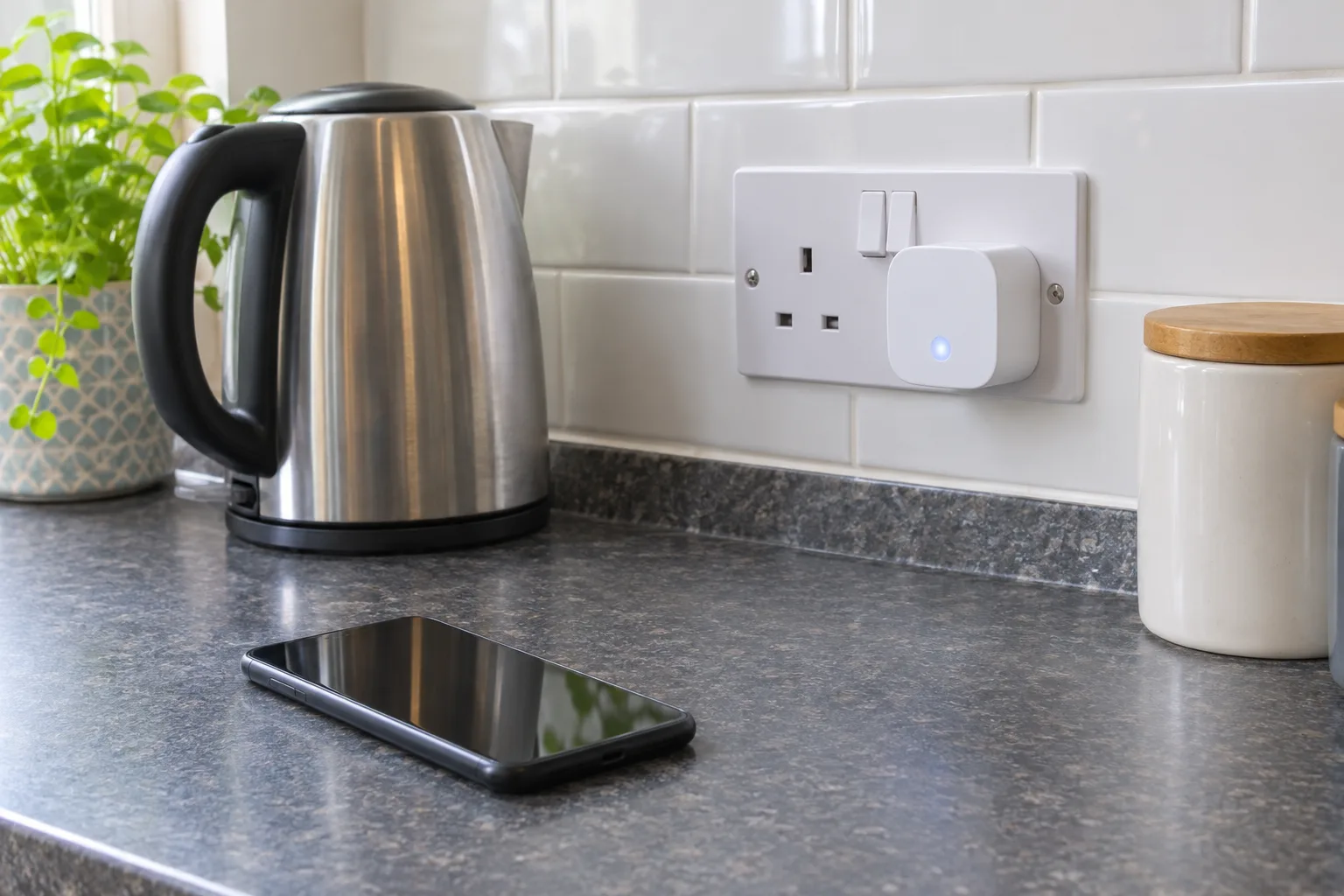
An energy monitoring smart plug measures the power going through it and shows it in an app. Typically you get:
- Watts right now: plug in a TV and see what it draws on standby and when it's on.
- kWh today, this week and this month: the real use, not the label.
- Cost: enter your unit rate and many apps show it in pounds and pence.
Use one as a detective. Move it from appliance to appliance for a day or two each, write down what you find, and you'll quickly see which items are worth changing. One monitoring plug can do the whole house this way.
Plain smart plugs without monitoring are cheaper and fine for timers and switching things off. Our smart plugs page shows which models monitor energy.
The plug uses power too
A smart plug stays connected to Wi-Fi all the time, so it draws a small amount of power itself. Using the table above, every watt it draws costs about £2.31 a year at today's cap. A plug that switches off 10 watts of standby for 20 hours a day comes out well ahead. A plug that switches a single phone charger probably doesn't.
So put smart plugs where they control several things, or where they stop something running for hours. Check the maker's figure for the plug's own use if it matters to you.
Safety: what not to plug in
- Check the maximum load. Every smart plug has one. Don't exceed it, and don't chain extension leads to get more sockets.
- Heaters: be careful with plug-in heaters and anything that could be a fire risk if switched on when nobody is home. Follow the appliance maker's advice on remote and timer control.
- Appliances that must not lose power suddenly, such as medical equipment, aquarium pumps or a PC mid update, don't belong on a timer.
- Outdoors: use only a plug rated for outdoor use, such as for Christmas lights.
Are smart plugs worth it?
Yes, if you use them for the right jobs:
- Buy one energy monitoring plug and use it to find out what your appliances really cost.
- Put plugs on groups of standby devices and on things you forget to switch off.
- Use them for convenience too: lamps on a timer while you're away, or the fan on from your phone. That's often why people keep using them.
Don't buy them expecting to cut your bill in half. A few pounds a year per plug, plus knowing where your money goes, is a fair expectation.
More ideas for each room are in our smart home section.
How we chose
Energy prices come from Ofgem's price cap unit rates and standing charges page, checked on 26 November 2026. The cost examples are worked out from those rates, not measured. We only add product cards to our guides where our delivered price is within 15% of the lowest delivered price we can find at other UK shops, so there are no product cards in this guide.
Frequently asked questions
Do smart plugs save money?
They can, usually a few pounds a year per plug. They save most when they switch off several standby devices at once or stop something running longer than needed. An energy monitoring plug also shows you where your money goes.
How much electricity does a smart plug use?
A small amount, because it stays connected to Wi-Fi. Each watt used all year costs about £2.31 at the October to December 2026 price cap rate of 26.32p per kWh. Check the maker's figure for a specific plug.
How much does it cost to leave a TV on standby?
It depends on the TV and what is plugged in with it. As a guide, 5 watts of standby for 20 hours a day costs about £9.61 a year at 26.32p per kWh. An energy monitoring plug will tell you the real figure.
What is the electricity price cap now?
From 1 October to 31 December 2026 the average Direct Debit rate is 26.32p per kWh with a 54.83p daily standing charge. From 1 January to 31 March 2027 it is 32.69p per kWh and 54.77p a day, according to Ofgem.
Can I use a smart plug on a fridge?
You can monitor a fridge's energy use with one, but never use it to switch the fridge off to save money. It needs to run to keep food safe.
Do energy monitoring smart plugs show cost in pounds?
Many apps do once you enter your unit rate. Otherwise they show kWh, which you multiply by the rate on your bill.