AI Costs for Small Business: Why AI Got So Cheap
AI costs for small business have collapsed since 2023. Here is why the price drop matters more than any model release, plus three rules to use it well.
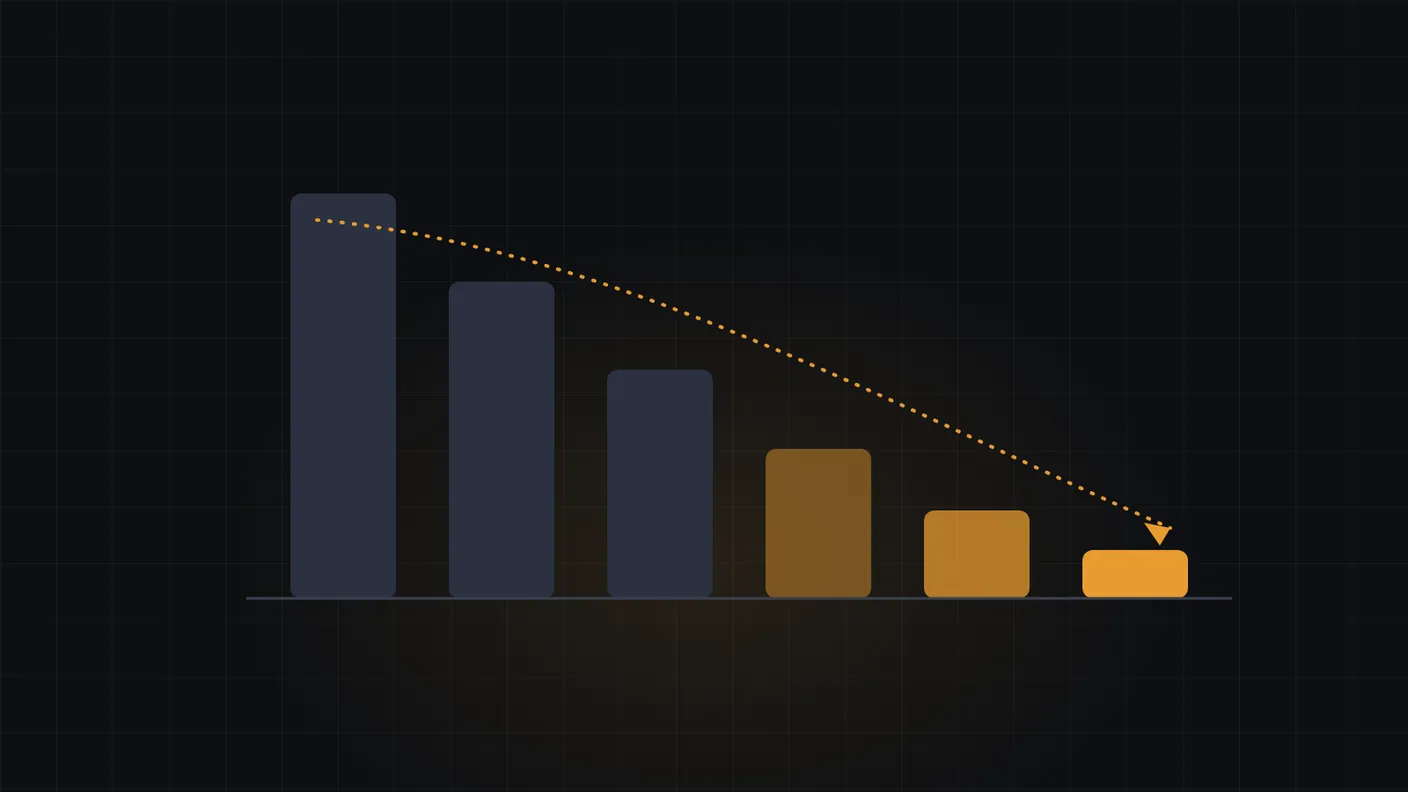
The most important development in AI for your business is not a model release: it is that AI costs for small business have collapsed, and that price drop matters more than GPT-4, Gemini or any agent demo. If you run a small or mid-sized UK firm wondering whether AI is finally affordable, this post is for you. By the end you will understand why the collapse happened, what it changes for an SME, and three rules for spending well, plus an honest note on where this thinking could be wrong. We are a Manchester technology business that advises and builds AI systems for UK small businesses, and we design caching-aware pipelines for clients because the economics, not the hype, decide what is worth doing.
Why did everyone focus on the wrong thing?
The headlines went to capability because capability is photogenic and price is not. A model that passes an exam or drives a browser makes a great demo; a graph of falling cost per token does not.
So the storyline that matters most to a small business barely made the news. Work that cost pounds per query on 2023’s frontier models now costs fractions of a penny. That collapse, not any single clever model, is why AI automation stopped being an enterprise toy and became something a Manchester trades firm or clinic can run profitably.
Here is the thing: the mechanics of that drop tell you where prices go next, which is exactly what you need to plan.
What actually made AI cheap?
AI got cheap because of a handful of unglamorous engineering breakthroughs, not one headline model. Each one chipped away at a different cost, and together they reset the economics.
| Cost lever | What changed | What it means for an SME |
|---|---|---|
| Model architecture | Sparse mixture-of-experts (Mixtral, December 2023) activates only the relevant part of a model per query | Big-model quality at a fraction of the running cost |
| Customisation | QLoRA, DPO and similar methods made fine-tuning and tuning far cheaper | Making a model “yours” became a line item, not a lab project |
| Prompt caching | The unchanging part of a request is stored, not reprocessed each call | High-volume workloads cost an order of magnitude less |
| Small models | GPT-4o mini, Gemini Flash, Claude Haiku: small, fast, capable | Most routine tasks run on cheap models with no quality loss |
| Competition | DeepSeek-R1 (January 2025) delivered open frontier reasoning at low cost | Pricing assumptions across the market were forced down |
Models stopped using all of themselves. The most important architectural idea of the period was the sparse mixture-of-experts, where each query activates only the relevant sub-networks. Mistral’s Mixtral in December 2023 put it into the open-model mainstream, and the effect was big-model quality at a fraction of the running cost, because most of the model sleeps through most questions.
Training and tuning got radically cheaper too. A string of research results, QLoRA squeezing large-model fine-tuning onto a single GPU, DPO simplifying preference training, made customisation a line item rather than a data-centre project.
The labs also learned to stop recomputing. Prompt caching, remembering the unchanging part of a request so it is not reprocessed on every call, sounds like an accounting trick, but at scale it routinely cuts a high-volume workload’s cost by an order of magnitude. Every serious automation pipeline leans on it, ours included.
Small models grew up alongside this. Models like GPT-4o mini, Gemini Flash and Claude Haiku handle most real business tasks (classify this email, extract these fields, draft this reply) without needing a frontier intellect. Vendors such as Anthropic and OpenAI now publish whole tiers built for exactly this, and matching the model to the task is the single easiest cost optimisation available.
Competition did the rest. DeepSeek-R1’s January 2025 release, frontier reasoning, fully open, built for a fraction of the assumed cost, forced everyone’s pricing assumptions down. The full open-versus-closed picture is worth its own read in our guide to open-weight versus closed AI models.
What does cheap intelligence change for a small business?
Cheap intelligence moves the constraint from the AI itself to the system you build around it. The cost of being clever has stopped being the bottleneck.
Run the arithmetic. An AI assistant that answers website enquiries, qualifies leads and books consultations handles a conversation for pence at frontier quality, and a fraction of that on a small model. A missed-call text-back automation costs effectively nothing per event. A document pipeline that summarises and files paperwork runs for less than the coffee of the person who used to do it.
What remains is the cost of building the system well: wiring it into your tools, setting boundaries, testing it, keeping it reliable. That is a one-off craft cost, not a scaling cost, which is exactly the shape of investment small businesses do well with. Pay once to build, then run at near-zero marginal cost. If you want concrete examples, our overview of what AI automation can actually do walks through them.
How should an SME spend on AI now?
Three practical rules follow from the economics, and they apply whether you are spending fifty pounds a month or five thousand.
- Right-size the model. Use frontier models where judgement matters, such as customer conversations, and small models for routine classification and extraction. The price difference is often five to twenty-five times for near-identical results on simple tasks.
- Design for caching. Pipelines structured to reuse stable context cost a fraction of naively built ones. This is invisible in a demo and decisive on a monthly invoice, which is why we build it in from the start.
- Revisit the maths yearly. Anything that was “too expensive to automate” in 2024 probably is not now. Prices keep falling, so your workflow list deserves an annual review.
Where could we be wrong?
We could be wrong about how long the price falls last, and it is worth saying so plainly. The collapse so far has been driven by efficiency research and fierce competition, and neither is guaranteed forever.
If competition consolidates, or if the next capability jump turns out to be genuinely expensive to run, the cost curve could flatten or even tick up for the best models. The cheapest small models will likely stay cheap, but “frontier capability for pennies” is an assumption, not a law.
That uncertainty does not change the advice, though. Right-sizing, caching and an annual review are sensible whether prices fall fast, slowly, or stall. The strategic takeaway is blunt either way: your competitors’ access to cheap intelligence is identical to yours, and the advantage goes to whoever turns it into working systems first.
That is the whole premise of our AI-driven business growth service. The consultation is free, and we will bring the cost arithmetic for your specific workflow with us.
Frequently asked questions
Why has AI become so much cheaper?
Several unglamorous breakthroughs stacked up: mixture-of-experts models that activate only part of themselves, cheaper fine-tuning methods, prompt caching that avoids recomputation, capable small models, and fierce competition. Together they cut the cost of capable AI from pounds per query to fractions of a penny.
How much can a small business save by choosing the right model?
For simple tasks like classification or extraction, a small model often produces near-identical results to a frontier model at a fraction of the price. The gap is commonly five to twenty-five times, so matching the model to the task is the easiest saving available.
What is prompt caching and why does it matter?
Prompt caching means storing the unchanging part of a request so it is not reprocessed on every call. For high-volume workloads it can cut costs by an order of magnitude. It is invisible in a demo but decisive on a monthly invoice, so we design pipelines around it.
If AI is so cheap, what actually costs money now?
The intelligence is rarely the constraint any more. The cost is building the system around it well: wiring it into your tools, setting boundaries, testing it and keeping it reliable. That is a one-off craft cost, not a per-use cost that grows with volume.
Will AI keep getting cheaper?
The trend has been steady price falls, roughly year on year, driven by efficiency research and competition. We expect it to continue, though not forever or at a guaranteed rate. The practical response is to revisit your automation list annually rather than betting on any single forecast.
Does cheap AI give my business a competitive edge?
Not on its own. Your competitors have the same cheap intelligence you do. The advantage goes to whoever turns it into working systems first. The differentiator is execution, not access, which is why building and integration matter more than the model price.